
Fix BI at the
Architecture Level,
Not the Dashboard Level
Define models, metrics, and security once, then let every report reuse them. Stop building tech debt.
When BI Grows Faster Than the Architecture
Most BI problems are architecture problems in disguise. Without a plan, you get chaos.
Finance vs. Ops Disconnect
Finance, sales, and operations report different numbers for “revenue” or “margin.” Reviews start with reconciliation.
Logic Divergence
Dashboards query source systems directly. Logic diverges by analyst, tool, and quarter.
Security Bottlenecks
No clear rules exist for who can see what. Risk and audit concerns slow down access to data.
The Usual Chaos
The Architecture Fix
The Architecture Dividend
Result: high BI spend, slow decisions, and limited trust in the numbers... Fixed at the foundation.
Core Capabilities in BI Architecture
BI Strategy & Target Architecture
Design BI as an operating layer, not a tool roll-out.
Decision & KPI Mapping
Map executive, functional, and operational decisions to the data they require. Prioritize domains by P&L impact.
Platform Alignment
Align existing tools (Power BI, Looker, Tableau) to a common pattern. Identify where current usage breaks governance.
Semantic Modeling & Metric Layer
Create one place where numbers are defined and enforced.
Domain Data Models
Design fact and dimension models for revenue, margin, churn. Implement conformed dimensions for customers and products.
History Handling (SCD)
Implement SCD patterns where required. Ensure historical views remain consistent when master data changes.
FROM raw_sales
WHERE status != 'fail'
// Logic buried in SQL
// Copied 50 times
from metrics.revenue
where region = 'NA'
// Logic defined centrally
// Reused everywhere
| Role | Region Access | PII Visibility |
|---|---|---|
| Admin | ALL | Show |
| EU Manager | EU_ONLY | Masked |
| Analyst | ASSIGNED | Masked |
Data Access & Security
Control who sees what, at acceptable speed and cost.
Security Model & RLS
Define row-level security by role, region, and BU. Align BI access with IAM.
Performance & Cost
Model expected query load. Configure BI and warehouse settings to keep cost per report within bounds.
Self-Service & Governance
Enable controlled self-service instead of uncontrolled sprawl.
Curated Data Sets
Publish governed data sets with clear joins, metrics, and row-level security applied. Limit direct access to raw tables.
Content Lifecycle
Define standards for creation, promotion, and archiving of dashboards. Introduce certification for official content.
Reporting & MIS Integration
Make detailed reporting run on the same architecture as dashboards.
MIS & Management Reporting
Align recurring MIS packs with the same semantic models as BI. Parameterize views for BU, region, and product lines.
Distribution & Scheduling
Architect refresh and delivery patterns for daily/weekly reporting. Integrate with email, portals, and embedded analytics.
Our Tech Stack






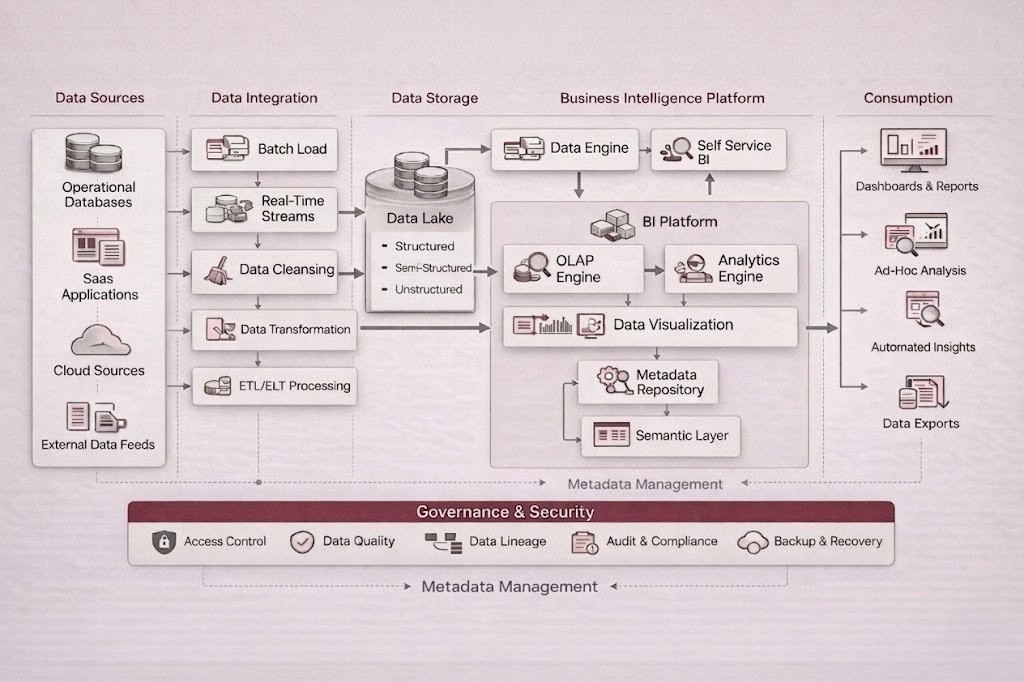
Problem → Architecture Fix → Result
Executive Reporting
Problem: Different versions of revenue and margin appear across decks. Close cycles drag.
Fix: Unified semantic layer; executive workspace anchored on certified KPIs.
Multi-Region Reporting
Problem: Regions maintain their own logic. Group consolidation is painful.
Fix: Shared conformed dimensions and core KPIs; local extensions layered on top.
Audit-Sensitive Envs
Problem: Audit trails are weak. Risk and finance push back on data trust.
Fix: Metric catalog, tested models, and lineage from dashboard to source.
Maturity Evolution
Phase 1 – Audit and Stabilize
Inventory tools, dashboards, and data sources. Identify conflicting metrics and high-risk reports.
Phase 2 – Architect and Rebuild
Design target BI architecture and semantic layer. Rebuild high-impact domains (finance, sales) on the new foundation.
Phase 3 – Scale and Govern
Onboard additional domains. Tighten performance, governance, and self-service patterns.
Commercial Certainty Pledge
If leadership expects BI to stand up under board questions and audits, architecture cannot remain implicit.